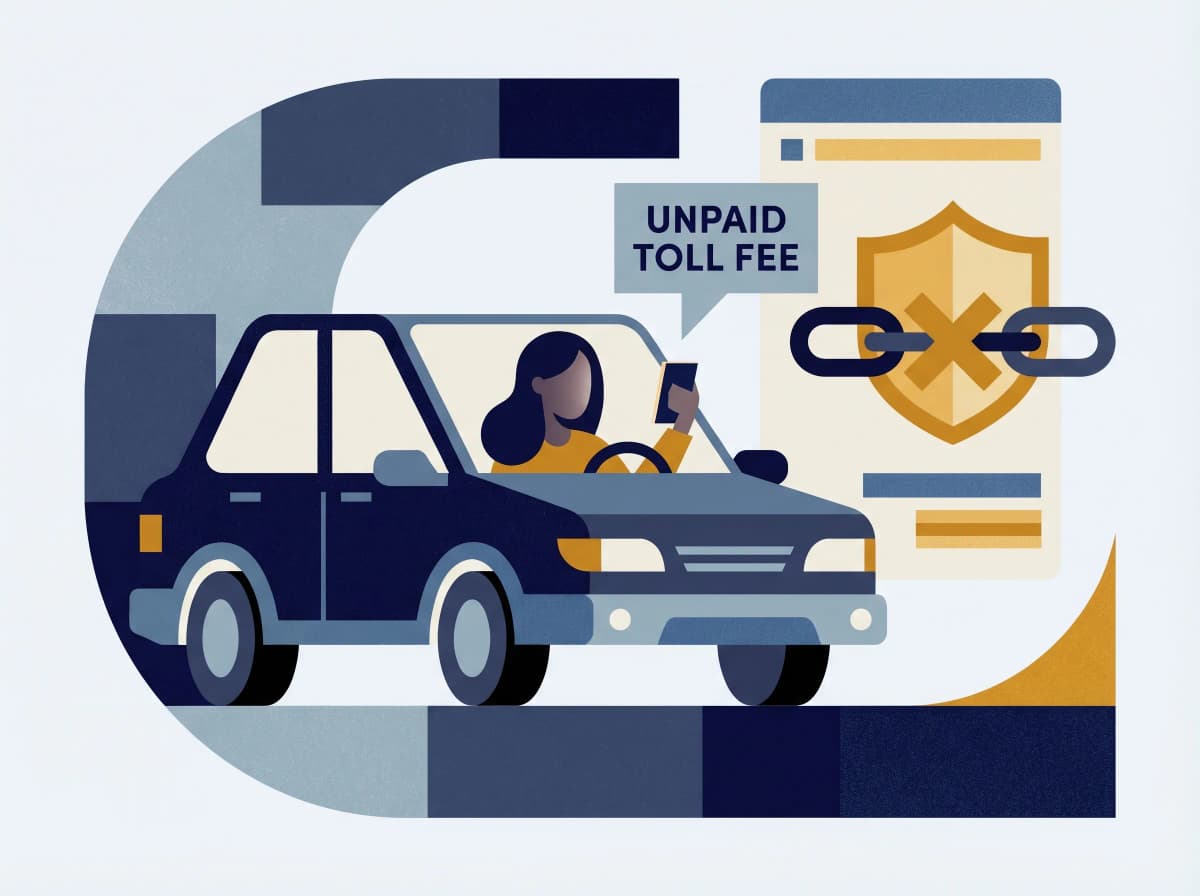
Toll Road Scam Texts Targeting Linkt and e-TAG Users
It always starts the same way. A text message lands. "Linkt: outstanding toll of $4.83. Pay within 24 hours to avoid a $14 administration fee." The amount is small enough that you don't really stop to think — it's plausible, it's mildly annoying, and the link is right there. One tap, card details in, done.
That's the entire scam. Toll-road phishing is one of Australia's most successful SMS-fraud campaigns because the amounts are tiny. It's not a $5,000 demand that triggers your defences. It's $4.83. You'd argue with $5,000. You wouldn't argue with $4.83.
This guide is the reason you should.
What's actually happening
Linkt is the customer-facing brand of Transurban, which operates most major toll roads in Sydney, Melbourne and Brisbane. e-TAG and other regional brands cover the rest. Together they're the gateway through which most Australian drivers interact with toll payments — which makes them the perfect impersonation target.
The scam is a high-volume SMS phishing operation. A criminal blasts millions of texts claiming a small unpaid toll, with a link to a website that looks identical to linkt.com.au but lives on a lookalike domain. When you click and "pay," the page doesn't process anything — it captures your credit card number, expiry, and CVV for resale or immediate fraud.
Common variants in 2025–2026:
- "Linkt: unpaid toll of $4.83. Avoid late fees: [link]"
- "e-TAG account suspended. Reactivate: [link]"
- "Final notice: $9.20 outstanding. Vehicle registration may be affected."
- "You have 1 unpaid toll. Resolve before midnight to avoid a court referral."
Linkt's parent company Transurban has publicly warned about toll-text phishing impersonating its brand. The National Anti-Scam Centre's Targeting Scams program tracks SMS phishing as a top-volume category every year. Reported losses cluster low — usually a few hundred dollars per victim — but the harvested card details are then resold or card-tested against larger purchases, where the real damage happens.
The "small amount" is bait. The card details are the prize.
Why this scam works so well
Three reasons specific to the toll-road context.
Plausibility. Most Australian drivers do interact with tolls occasionally. The exact amount looks like a real toll — because the criminals know real toll prices and price their fakes within the credible range.
Authority cue. The threat of "vehicle registration suspension" or "court referral" sounds plausible enough that a tired driver doesn't question it. Real toll-payment escalations are very different — and very slow — but the average recipient doesn't know that.
Time pressure. "Pay within 24 hours." The window forces a decision before the recipient has time to verify. The whole campaign is calibrated to outpace the time it takes to log in to the official Linkt site and check.
Linkt and other Australian toll operators never send you a payment link via SMS. They send notices via the Linkt app, by email from @linkt.com.au addresses, or — for genuinely overdue accounts — by postal mail to your registered address. If a text contains a payment link, it isn't from Linkt. Full stop.
What real toll-road communication actually looks like
A short rulebook that closes the door on every variant.
- Real Linkt messages come through the Linkt app first. Push notifications inside the app, not as an SMS.
- Real Linkt emails come from
@linkt.com.au. Notlinkt-au.com, notlinkt.support, nottolls.linkt-au.net. - Real Linkt postal notices give you weeks, not 24 hours, and contain a reference number you can quote on the phone.
- Real Linkt phone calls — when they happen — never ask for credit-card details over the phone. They direct you back to the app or website to pay.
- Real Linkt amounts are visible inside your account. Log in at linkt.com.au or in the app; if the disputed toll isn't there, it doesn't exist.
If a message breaks any of those rules, it's a scam.
The ten-second test
Any toll text. Any time. Run this list.
1. Look at the sender. Is it "Linkt", or a random mobile number? Random numbers are a red flag.
2. Look at the link. Tap and hold to preview. Real links end in linkt.com.au. Fake ones contain linkt somewhere in the middle of an unrelated domain.
3. Look at the amount. Real Linkt charges a single trip — they don't bundle "$4.83 outstanding" without context. Inside the real Linkt app, every charge has a date, a road, and a vehicle attached.
4. Look at the threat. Vehicle registration suspension via SMS isn't a thing. Court referrals via SMS aren't a thing.
5. When in doubt, go direct. Open the Linkt app or type linkt.com.au into your browser yourself. If a real charge is owed, it'll be there.
If you've already paid
Call your bank first. Card-testing happens within minutes of harvest, and the difference between a $4.83 loss and a $4,000 loss is how fast you reach a fraud line. Other reports can wait.
1. Call your bank's fraud line — from a different phone if possible.
- CommBank: 13 2221
- Westpac: 132 032
- NAB: 13 22 65
- ANZ: 13 33 50
- Macquarie: 1800 622 742
Tell them: "I entered card details on a phishing site — block and replace, please." Flag any pending charges as unauthorised.
2. Forward the scam SMS to 0429 401 703. That's the cross-industry scam-reporting number; Linkt also accepts reports at scamreports@linkt.com.au.
3. Report to Scamwatch. scamwatch.gov.au or 1300 795 995. The reference number is useful if you later seek a refund under the ePayments Code.
4. Check your Linkt account directly. Log in at linkt.com.au or via the app. Note any genuinely outstanding tolls — and pay those through the official channel.
5. Monitor statements for two billing cycles. Card-testing fraud often shows up days later as small charges from unfamiliar merchants. Anything you don't recognise — dispute immediately.
A two-minute hardening checklist
Stops the next round of toll-text phishing landing as a near-miss.
1. Install the Linkt app. Once installed, every real toll notification arrives as an in-app push — not an SMS. The app is the source of truth; SMS becomes irrelevant.
2. Stop saving credit cards in your browser. Chrome and Safari autofill make phishing forms feel "right." A dedicated password manager (1Password, Bitwarden, Apple Passwords) only autofills on the real domain — its silence on a lookalike site is the alarm bell.
3. Add card-not-present caps in your bank app. Most major Australian bank apps let you set a daily online-spend limit or freeze card-not-present transactions with one tap.
4. Consider a single-use virtual card for online purchases. CommBank, ING, and several others now offer one-time virtual card numbers — tied to your real account but unusable after the transaction.
5. Tell one family member this week. Toll-text scams hit younger drivers and renters who don't have a strong mental model of how toll-road billing actually works. A two-minute conversation immunises them.
The bottom line
Toll-text scams work because the amount looks like background noise. The fix is to make the channel the warning sign instead of the amount: real Linkt notifications come through the Linkt app, not SMS. Once that's your habit, any toll-related text becomes instantly visible as a scam — regardless of how plausible the dollar figure looks.
If a text ever sits in your hand and feels wrong, paste it into Ask Arthur. Five seconds, free, Australian threat data behind it.
If you've entered card details on a fake toll-road page, call your bank's fraud line immediately and report to Scamwatch on 1300 795 995. To report scam SMS to Linkt, email scamreports@linkt.com.au or forward the message to 0429 401 703.
Ask Arthur is Australia's friendly scam-detection companion, built locally with Australian threat intelligence. For more guides and real-time alerts, visit askarthur.au.
Related posts

Think you've received a scam?
Check it instantly — free, private, no signup.
Check nowStay ahead of scams
Weekly alerts delivered to your inbox every Monday.